
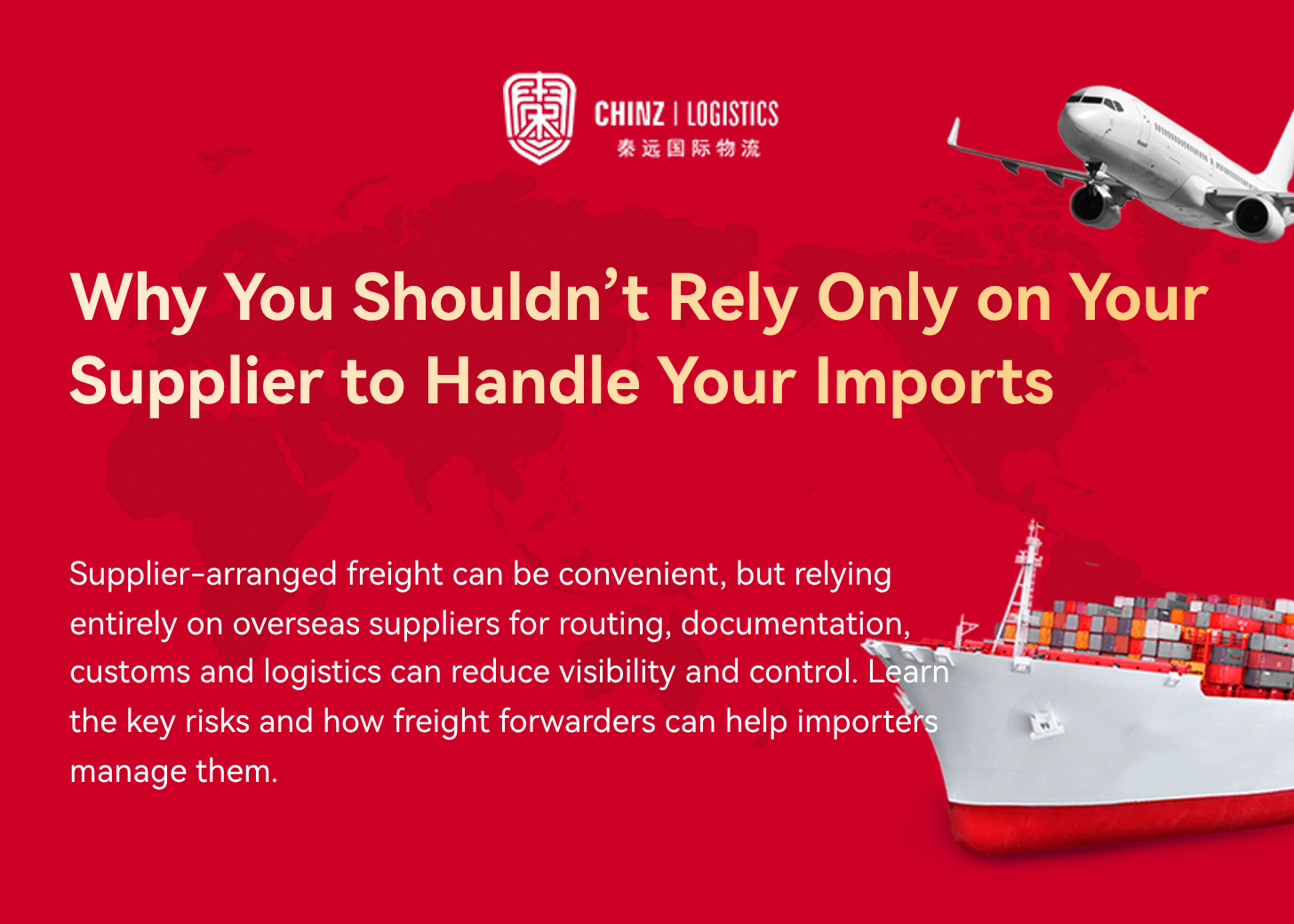
Many first-time importers choose the simplest option:
Let the supplier arrange everything.
The supplier manufactures the goods and also organises:
• Freight bookings
• Ocean transport
• Shipping documents
• Overseas agents
This is not automatically a bad arrangement.
Supplier-arranged freight under terms such as CIF, CFR or DAP is common in international trade.
The real risk appears when the importer has little independent visibility over:
• Routing
• Documentation
• Customs
• Destination charges
• Final delivery
Why May a Supplier Not Manage the Entire Import Chain?
Suppliers generally specialise in:
Manufacturing + Export.
Their core expertise is often:
• Production
• Products
• Packing
• Factory schedules
Australian imports may additionally involve:
• Customs
• Biosecurity
• Tariff classification
• Import permits
• Destination charges
• Container cartage
• Local delivery
• Warehouse requirements
These may sit outside the supplier's core expertise.
The question is therefore not:
Can the supplier book freight?
It is:
Who is managing the entire supply chain?
Risk 1: Delays
International freight can involve:
Supplier
↓
Origin Warehouse
↓
Export Customs
↓
Shipping Line
↓
Transshipment
↓
Australian Port
↓
Customs / Biosecurity
↓
Final Delivery.
Where the importer relies entirely on supplier communications, information may need to travel through several parties before reaching the buyer.
Long communication chains can make exceptions harder to resolve.
What Can Cause Delays?
Examples include:
• Incomplete Commercial Invoices
• Packing List errors
• Bill of Lading discrepancies
• Cargo reporting issues
• Missing origin documents
• Biosecurity documentation problems
• Import permits not confirmed
• Destination agents contacting the buyer too late
Sea cargo arriving in Australia is also subject to pre-arrival cargo-reporting requirements.
Documentation should therefore be prepared before the vessel arrives.
Risk 2: Import Compliance
A supplier may understand export procedures in the origin country without having detailed knowledge of:
Australian Import Requirements.
Depending on the cargo, the importer may need to consider:
• HS classification
• Customs value
• Rules of origin
• Duty and GST
• Biosecurity
• Product compliance
• Import permits
Processes used for another destination country may not necessarily be suitable for Australia.
Who Is Responsible for the Australian Import Declaration?
In Australia, an Import Declaration can be submitted by:
• The owner/importer
or
• An ABF Licensed Customs Broker acting on their behalf.
A freight forwarder is not automatically a licensed customs broker.
Importers should therefore clearly identify:
Who manages freight?
Who prepares the customs entry?
Who coordinates biosecurity?
Risk 3: Reduced Supply-Chain Control
Under a supplier-controlled shipment, the buyer may receive only:
ETD
and:
ETA.
However, commercial importers may also need visibility of:
• Carrier
• Direct or transshipment route
• Actual transit time
• Destination agent
• Local charges
• Free time
• Cargo availability
• Final delivery arrangements
This information directly affects inventory planning.
Is Supplier Freight Always Cheaper?
No.
International shipping should be compared using:
Total Landed Logistics Cost.
A low CIF ocean freight rate can still be accompanied by destination costs such as:
• Handling
• Documentation
• CFS charges
• Depot charges
• Cartage
• Storage
This is particularly important for LCL shipments.
Risk 4: Limited Tracking Visibility
Supplier-controlled freight can sometimes create a tracking chain such as:
Importer → Supplier → Forwarder → Carrier.
An importer-appointed freight forwarder may have direct access to:
• Carrier tracking
• Vessel schedules
• Terminal information
• Shipment milestones
This can improve visibility and exception management.
Tracking Is Not Always Live GPS
Normal container tracking usually provides:
• Booking events
• Gate-in
• Vessel loading
• Departure
• Transshipment
• ETA
• Arrival
• Cargo availability
Continuous cargo-level GPS, temperature, shock or door monitoring may require separate IoT tracking equipment.
Risk 5: Problems Become Harder to Manage
Common freight exceptions include:
• Cargo rollover
• Blank sailing
• Customs holds
• Biosecurity inspections
• Cargo damage
• Container storage
• Delivery issues
Where the supplier, origin forwarder, Australian agent and importer have unclear responsibilities, problem resolution can become slow and fragmented.
Packing and Load Restraint Matter
Poor packing at origin can create problems when cargo reaches Australia.
Palletised cargo may need appropriate:
• Wrapping
• Strapping
• Load restraint
Australian heavy-vehicle rules require loads to be safely placed and restrained.
Responsibility can involve multiple parties that control or influence packing, loading and transport activities.
Problems are therefore best prevented at origin.
What Does a Freight Forwarder Add?
An importer-appointed freight forwarder may coordinate:
• Route selection
• Carrier selection
• LCL/FCL comparisons
• Bookings
• Origin handling
• Document review
• Customs coordination
• Biosecurity coordination
• Tracking
• Australian delivery
This creates a clearer separation:
The supplier makes the goods.
The forwarder manages the movement of the goods.
Can a Freight Forwarder Eliminate Delays?
No.
No logistics provider can guarantee that international freight will never be delayed.
The real value is:
• Identifying risks earlier
• Improving visibility
• Coordinating multiple parties
• Providing alternatives when problems occur
Good freight management is primarily about controlling uncertainty.
What About Cargo Insurance?
Some freight forwarders can also help importers obtain or arrange:
Marine Cargo Insurance.
This can be particularly relevant for:
• High-value cargo
• Machinery
• Furniture
• Electronics
• Commercial inventory
Insurance should ideally be considered at the booking stage rather than after damage occurs.
Should Every CIF Shipment Be Changed to EXW?
No.
There is no universally best Incoterm.
EXW gives the buyer greater control but also requires the buyer to manage more origin responsibilities.
For international containerised or multimodal trade, FCA may sometimes better reflect the actual delivery arrangement.
The correct choice depends on:
• Cost
• Control
• Risk
• Practicality
How Do Common Incoterms Differ?
EXW:
Buyer takes significant responsibility from the seller's premises.
FCA:
Seller completes delivery at the agreed point and handles export clearance; often suitable for containerised or multimodal freight.
FOB:
Common in sea trade where risk transfers once cargo is loaded on board, although FCA may better suit some containerised movements.
CFR:
Seller pays the main sea freight, while the buyer bears cargo risk after loading and should consider insurance.
CIF:
Seller arranges the main freight and required cargo insurance, but buyers should still review the actual insurance cover.
When Can Supplier-Arranged Freight Work Well?
Supplier freight may be perfectly suitable where:
• The supplier has a reliable logistics setup
• Destination charges are transparent
• Routes and carriers are visible
• The buyer controls Australian customs clearance
• Insurance coverage is understood
• Previous shipments have performed reliably
The key issue is not who books the freight.
It is whether the importer has:
Visibility + Control.
When Is Importer-Controlled Freight Particularly Useful?
It can be useful for businesses with:
• Multiple suppliers
• Regular shipments
• Frequent LCL cargo
• High-value goods
• Machinery
• Biosecurity-sensitive cargo
• Complex Australian delivery requirements
• Regular carrier comparisons
• Centralised tracking requirements
Why Consolidate Multiple Suppliers?
Instead of three suppliers arranging three separate shipments:
Supplier A ┐
Supplier B ├→ China Warehouse → Consolidation → Australia
Supplier C ┘
cargo can potentially be consolidated and moved as:
LCL
or:
FCL
depending on total volume.
This may improve freight visibility and cost management.
What Should You Look for in a Freight Forwarder?
Consider:
• Australian import experience
• Route options
• Destination network
• Tracking capability
• Customs brokerage arrangements
• Biosecurity coordination
• Local delivery capability
• Cost transparency
• Exception management
The lowest ocean freight rate is only useful if the cargo reaches its final destination efficiently.
Who Should Be Responsible for What?
A practical supply chain may divide responsibilities as follows:
Supplier:
Production + Packing + Export Documents.
Freight Forwarder:
Transport + Booking + Tracking + Delivery Coordination.
Licensed Customs Broker:
Import Declaration + Customs Brokerage.
Importer:
Commercial Decisions + Product Compliance + Accurate Information + Approval.
Clear responsibilities reduce confusion when problems occur.
What Should Be Confirmed Before Shipment?
Before cargo departs, confirm:
• Incoterm
• Cargo description
• HS code
• Country of origin
• Cargo-ready date
• Packing
• LCL / FCL / Air Freight
• Carrier and route
• Customs broker
• Biosecurity requirements
• Destination charges
• Marine insurance
• Final delivery
• Tracking method
The situation importers should avoid is:
Learning how their shipment works only after it is already on the water.
Chinz Logistics China-to-Australia Freight
Chinz Logistics provides China-to-Australia and international freight services, including:
• China to Australia sea freight
• China to Australia air freight
• LCL shipping
• FCL shipping
• China collection and warehousing
• Buyer's consolidation
• Multi-supplier consolidation
• Export customs support
• Australian import clearance coordination
• Biosecurity-related logistics coordination
• Shipment tracking
• Container cartage
• Australian local delivery
• Machinery and Project Cargo
Businesses currently using supplier-arranged freight can compare:
Supplier Freight vs Importer-Controlled Freight
across:
Total Cost + Transit Time + Control + Risk.
If you are preparing a China-to-Australia shipment, provide:
Cargo description + number of suppliers + Incoterm + package count + packed dimensions/weight + total CBM + total weight + Chinese origin + Australian suburb/postcode + cargo-ready date
to help assess a suitable freight solution.