
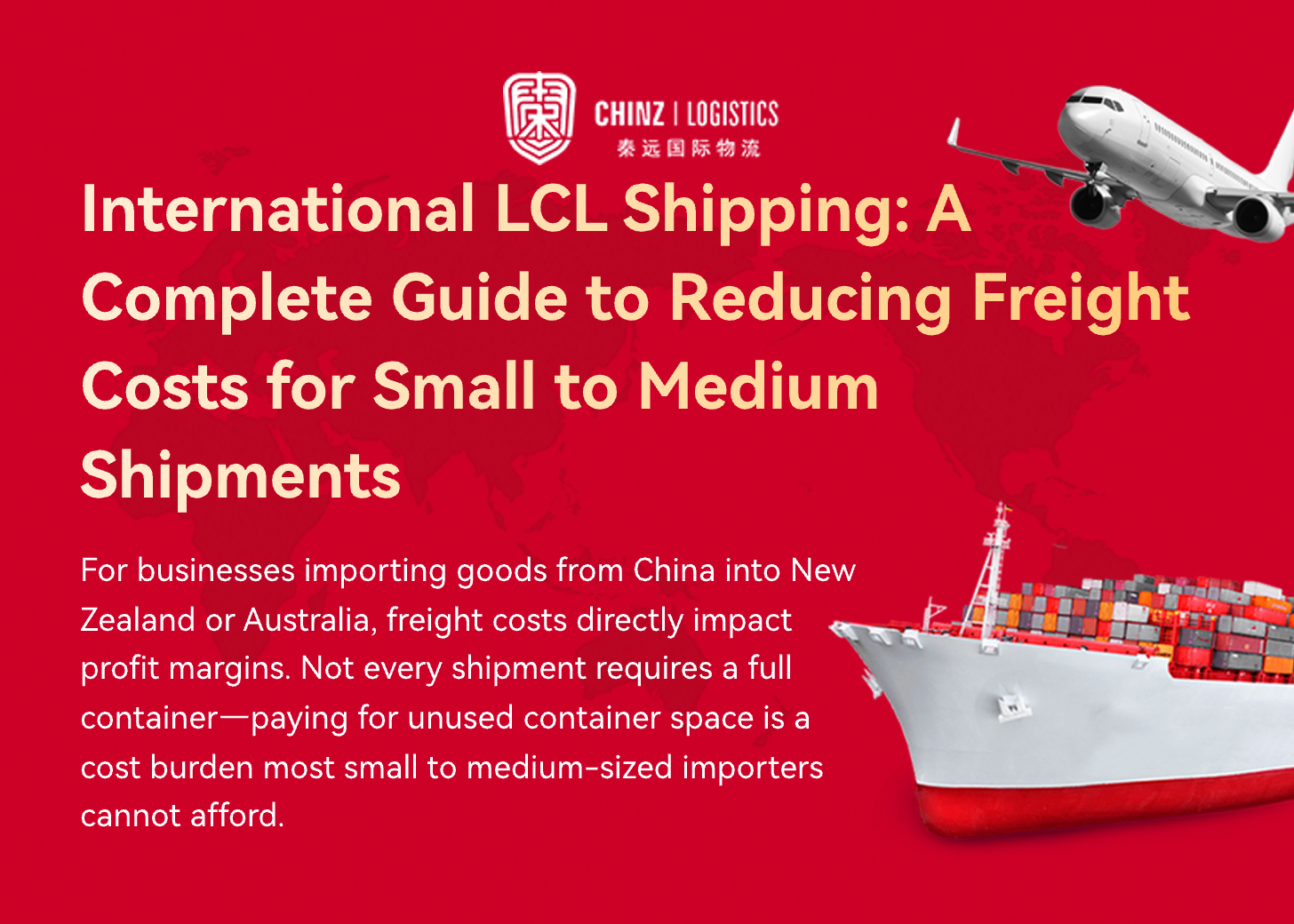
For businesses importing goods from China into New Zealand or Australia, freight costs directly impact profit margins. Not every shipment requires a full container—paying for unused container space is a cost burden most small to medium-sized importers cannot afford. LCL (Less than Container Load) shipping is the strategic answer to this challenge. This guide breaks down how LCL works, when to use it, its cost structure, and key operational considerations—so you can make import decisions with full cost control and process clarity.
What Is LCL (Less than Container Load) Shipping?
LCL stands for Less than Container Load. Under this shipping model, your cargo shares a container with goods from other importers, and you only pay for the actual volume your goods occupy—typically billed per cubic metre (CBM). LCL is a core component of the international freight consolidation system. Freight forwarders consolidate multiple LCL shipments bound for the same destination port into a single container, manage export customs clearance as one unit, and arrange deconsolidation and distribution at a designated warehouse once the container arrives at the destination port.
Which businesses and cargo types are suited to LCL?
Traders and wholesalers shipping 1–15 CBM per consignment; businesses testing new suppliers or product lines; e-commerce brands running multi-SKU inventory models; personal international relocations and furniture shipping; builders and contractors sourcing small-volume building materials.
How LCL shipping works—step by step:
Step 1: The supplier delivers goods to the freight forwarder's nominated consolidation warehouse (typically located in port cities such as Shenzhen, Guangzhou, Shanghai, or Ningbo). Step 2: The warehouse verifies cargo volume, inspects goods, and consolidates them with other LCL shipments into a container. Step 3: The container is loaded onto a vessel and exported as a full container, with an LCL bill of lading issued. Step 4: The vessel arrives at the destination port (e.g., Auckland, Sydney, Melbourne). Step 5: The container is deconsolidated at a bonded warehouse. Step 6: Individual consignments clear customs separately and are arranged for collection or delivery.
Key Advantages of Choosing LCL Shipping for Your Business
No need to pay for a full container.A 20-foot container holds approximately 28 CBM. If you consistently ship only 4–8 CBM per consignment, booking an FCL means paying for a significant amount of wasted space. LCL lets you pay only for the capacity you actually use, potentially saving 40%–60% on freight costs compared to FCL during low-volume periods.
Ideal for small-volume, high-frequency exports.Businesses operating lean inventory models—purchasing smaller quantities at higher frequencies—stand to benefit significantly from LCL. It supports just-in-time replenishment strategies and avoids tying up capital in warehousing surplus stock.
Reduced inventory and working capital pressure.Because each shipment is smaller and more frequent, the financial strain of goods in transit and in storage is substantially reduced. This is particularly important for furniture, building materials, and seasonal goods—categories where demand forecasting often involves significant uncertainty.
Flexible sailing schedules and destination port options.LCL services from China's major ports (Shanghai, Ningbo, Shenzhen, Guangzhou) to New Zealand (Auckland, Christchurch, Wellington) and Australia (Sydney, Melbourne, Brisbane, Fremantle) run on dense weekly schedules, with regular consolidation sailings, short waiting times, and flexible planning.
How LCL Freight Costs Are Calculated
Understanding LCL cost composition is essential for budget control and avoiding unexpected charges.
Charged by volume or weight.LCL freight is billed per cubic metre (CBM) as the base unit. The freight forwarder calculates volume based on the external dimensions of the cargo packaging. In most cases, actual volume applies; however, if the cargo has high density and is particularly heavy, the chargeable weight may be calculated at a ratio of 1 CBM to 1,000 kg. Always confirm with your forwarder whether actual volume or chargeable weight is being applied when reviewing quotations.
Origin charges.These include export customs clearance and documentation fees, trucking from the supplier to the consolidation warehouse, CFS (Container Freight Station) handling charges at origin, bill of lading issuance fees, and port security and terminal handling charges.
Destination charges.These include destination terminal handling charges, deconsolidation and distribution fees, customs clearance and biosecurity inspection fees, import duties and GST (depending on the commodity category and destination country), and local delivery to the designated address.
A professional freight forwarder will provide a fully itemised cost breakdown before booking. Chinz Logistics is committed to supplying a complete cost breakdown at the quotation stage, with transparent destination port charges and no hidden fees. Be wary of quotations that offer an extremely low freight rate only to add substantial markups at the destination end.
Key Considerations for LCL Shipping
Warehouse cut-off and documentation cut-off deadlines must not be overlooked.LCL shipping operates on strict timelines. Consolidation warehouses have cargo receipt cut-off times (typically 3–5 days before vessel departure), and shipping lines impose documentation submission deadlines. Missing either deadline means your cargo will be rolled to the next sailing—potentially delaying your shipment by 7–10 days. Always confirm the exact cut-off dates with your freight forwarder and allow buffer time for your supplier's delivery.
Packaging and cargo securing.Your goods travel inside a container mixed with cargo from other shippers. During ocean transit, containers are subject to vibration, stacking pressure, and shifting forces. LCL cargo must meet the following packaging requirements: use export-grade, reinforced cartons or wooden crates; palletise wherever possible to facilitate mechanical handling; use edge protectors and strapping for reinforcement; add moisture barriers for goods susceptible to dampness; clearly mark each package with consignee information and shipping marks. Inadequate packaging is the single most common cause of LCL cargo damage—and it is entirely preventable.
Restrictions on sensitive and dangerous goods.Not all cargo is suitable for LCL shipping. Dangerous goods (DG) classified items, certain chemicals, lithium batteries, and some liquid goods require special handling arrangements or are prohibited from mixed-container shipping. Always declare cargo information accurately. Concealment or misdeclaration can result in the entire container being rejected for loading, fines, or even legal liability.
Destination deconsolidation and collection arrangements.Once the container arrives, it must be deconsolidated at a bonded warehouse. This process typically takes 1–3 business days, depending on port congestion and inspection schedules. After deconsolidation, you can choose self-collection or arrange delivery through your freight forwarder. Always factor deconsolidation time into your overall transit time estimates—this is a common source of actual delays.
How to Choose a Reliable LCL Freight Forwarder
When evaluating LCL freight forwarders, consider the following dimensions: consolidation sailing frequency—confirm whether there are weekly LCL services from China's major ports to your destination, and whether the forwarder operates its own consolidation service rather than simply reselling slots; in-house customs brokerage—when a forwarder has both freight and customs clearance capabilities, clearance handovers are smoother and accountability is clearer; cost transparency—all charges are itemised upfront, with no hidden fees at destination; milestone tracking capability—end-to-end visibility from warehouse receipt to final delivery; destination local capability—a forwarder with a local team or close partners in New Zealand or Australia will respond to issues far faster than a remote operator.
Chinz Logistics operates weekly LCL services from Shanghai, Ningbo, Shenzhen, and Guangzhou to major ports in New Zealand and Australia. With in-house customs brokerage and a full-chain tracking platform, Chinz provides end-to-end management from supplier pick-up in China to destination delivery, along with tailored enterprise logistics solutions for clients across different industries.
Common Mistakes Importers Make with LCL Shipping
Underestimating total transit time.Due to consolidation and deconsolidation stages, LCL overall transit time is longer than FCL. Port-to-port from China to New Zealand or Australia is estimated at 25–35 days, plus an additional 3–7 days for deconsolidation and delivery.
Overlooking destination charges.Focusing solely on the freight rate while ignoring destination fees. Always request a complete DAP or DDP quotation.
Unclear shipping marks.Unmarked or poorly marked cargo can be misplaced during deconsolidation and distribution. Every item must carry clear consignee identification.
Mixing incompatible cargo.Heavy machinery and fragile furniture consolidated in the same container carry a high risk of damage. Always confirm cargo compatibility with your forwarder when booking.
Neglecting freight insurance.Marine cargo insurance premiums are typically only 0.3%–0.5% of the cargo value. For LCL shipments, which involve more handling stages, securing insurance is strongly recommended.
Is LCL Shipping Right for Your Next Shipment?
LCL sea freight is one of the most viable logistics models for small to medium-sized enterprises importing from China. LCL is the best fit when: per-shipment volume is under 15 CBM; you procure regularly but in smaller quantities; you are trialling new products; you need stable, predictable sailing schedules. For furniture retailers, building materials suppliers, and wholesale importers in New Zealand and Australia, LCL is not merely a cost-saving measure—it is the logistics backbone that keeps their business model running.
To assess your next shipment's freight options and receive a detailed LCL vs FCL cost comparison, Chinz Logistics offers free quotations for shipping from China to New Zealand and Australia, with all charges itemised and full process transparency guaranteed.