
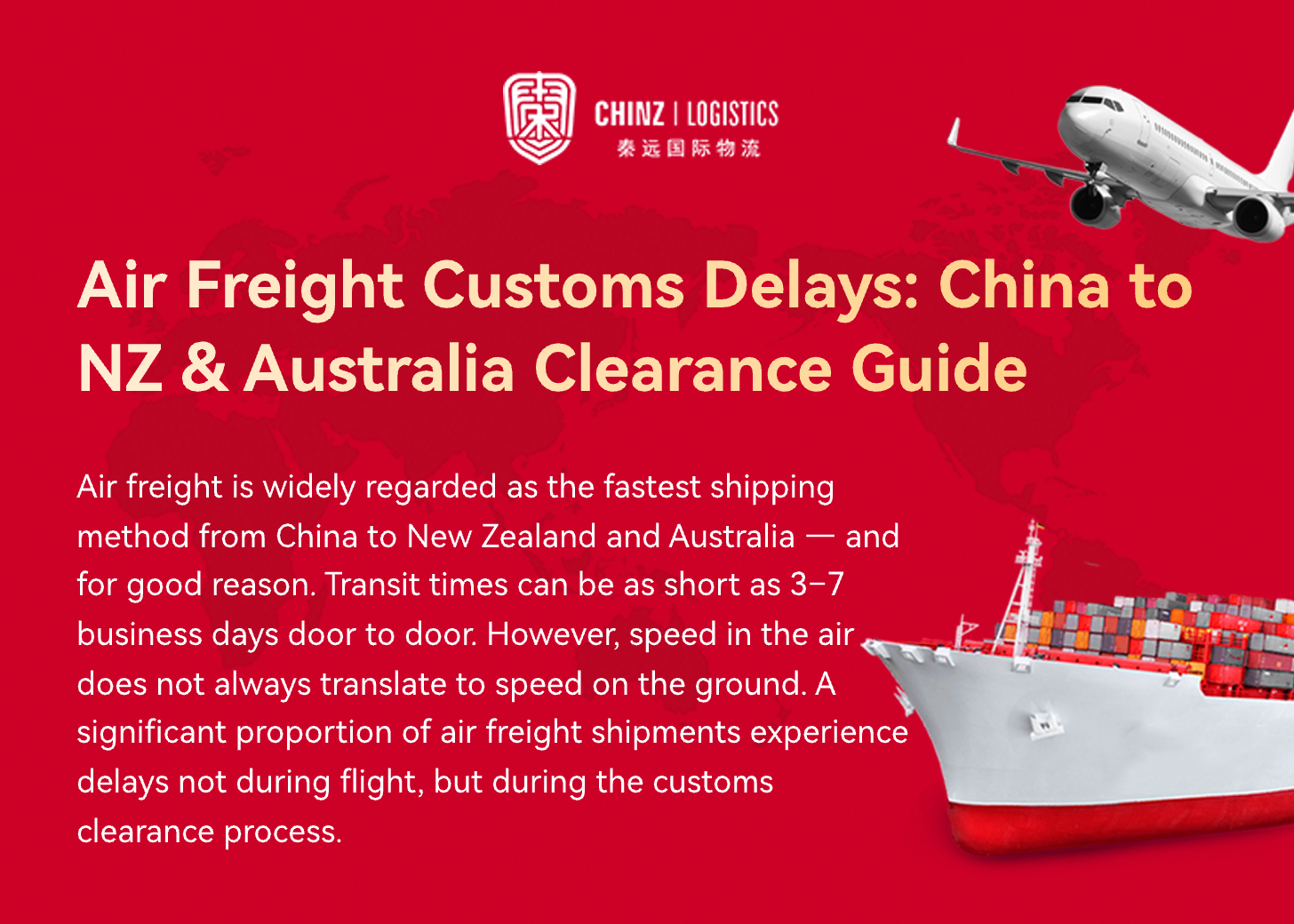
Air freight is widely regarded as the fastest shipping method from China to New Zealand and Australia — and for good reason. Transit times can be as short as 3–7 business days door to door. However, speed in the air does not always translate to speed on the ground. A significant proportion of air freight shipments experience delays not during flight, but during the customs clearance process. If you have ever wondered why your air freight parcel is stuck at "customs clearance in progress" for days, this guide walks you through the common causes, how to prepare correctly, and what to look for in a freight forwarder to minimise risk.
Common Reasons for Air Freight Customs Delays
Understanding why delays happen is the first step to preventing them. Below are the most frequent causes we see at Chinz Logistics when handling air freight from China to New Zealand and Australia.
Incomplete or Vague Cargo Declarations
Customs authorities in both New Zealand and Australia rely on accurate cargo descriptions to assess duties, biosecurity risks, and compliance. Declarations such as "gifts," "personal effects," or "household items" without further detail are red flags. When customs officers cannot determine exactly what is inside a shipment, they place it on hold for manual inspection — adding anywhere from 1 to 5 business days to your timeline. Always provide specific descriptions: material composition, intended use, quantity, and unit value.
Incorrect or Missing Documentation
Air freight requires a commercial invoice, packing list, and airway bill at minimum. For commercial shipments, additional documents such as a certificate of origin, supplier declaration, or import permit may be required depending on the goods. A single missing document can halt the entire clearance process. We recommend preparing a document checklist before dispatch and having your forwarder review it.
Undeclared or Misdeclared Sensitive Goods
Items such as food products, supplements, cosmetics, liquids, powders, and battery-containing devices fall into regulated categories. If these are shipped without prior confirmation from your forwarder and without the required permits or labelling, customs will flag them. In some cases, undeclared prohibited items can result in seizure, destruction, or return at the sender's expense.
Packaging That Does Not Meet Requirements
Poorly packaged goods — especially fragile items, liquids, or electronics — can trigger inspection. Customs and border agencies have the right to open and inspect any package. If packaging is inadequate and goods are damaged during inspection, liability falls on the shipper. Proper packaging is not just about protection; it is a compliance requirement.
Address and Contact Errors
A shipment that clears customs smoothly can still be delayed during last-mile delivery if the consignee's address, phone number, or email is incorrect. In New Zealand and Australia, courier services will attempt delivery and often require someone to be present for signature. Failed delivery attempts add 1–2 business days per attempt.
Biosecurity Interventions
Both New Zealand (MPI) and Australia (DAFF) enforce strict biosecurity controls. Wooden packaging materials, used sporting equipment, shoes with soil residue, and certain food items are common triggers. Biosecurity inspections may incur additional fees and extend clearance time by 2–7 business days. Always declare wooden pallets or crates and ensure they meet ISPM 15 treatment standards.
Documents You Need for Air Freight Clearance
Preparing the right documents before your shipment leaves China is the single most effective way to prevent customs delays. Here is what you typically need.
For personal shipments:
- Consignee's full name, phone number, and delivery address
- Detailed description of each item (what it is, what it is made of)
- Quantity and estimated value per item
- Purchase receipts or proof of value (if applicable)
For commercial shipments:
- Commercial invoice with HS codes, unit prices, total value, and incoterms
- Packing list detailing dimensions, weight, and contents of each carton
- Air waybill (AWB) issued by the airline or forwarder
- Certificate of origin (if claiming preferential tariff treatment)
- Import permit or licence (for regulated goods)
- Supplier declaration (for FTA claims)
At Chinz Logistics, we review documentation before cargo leaves our warehouse. This pre-departure check catches errors early — before they become customs problems on the other side.
Goods That Must Be Confirmed Before Air Freight Shipping
Certain categories of goods require advance confirmation from your freight forwarder. Do not assume something can be shipped just because it is available for purchase online.
- Food and beverages — subject to biosecurity and food safety regulations in NZ and Australia. Many food items require import permits or must meet specific labelling standards.
- Health supplements and medicines — regulated by Medsafe (NZ) and the TGA (Australia). Some vitamins and supplements may be classified as therapeutic goods.
- Cosmetics and skincare — ingredients lists must be reviewed. Products containing certain chemicals or animal-derived ingredients may be restricted.
- Liquids and powders — require special packaging and may be subject to additional screening by airline security.
- Batteries and electronics — lithium batteries are classified as dangerous goods (DG) and must be declared. UN38.3 test certification and proper DG packaging are mandatory.
- Branded goods and luxury items — customs will scrutinise declared values. Under-declaring the value of branded goods to reduce duty can result in penalties, seizure, and blacklisting.
- Wooden products and plant-material items — must meet ISPM 15 treatment standards and may require fumigation certificates.
How to Use Freight Tracking to Monitor Your Shipment
One of the most overlooked tools in preventing delay anxiety is active shipment tracking. Modern air freight services provide tracking visibility across multiple stages:
- Cargo received at origin warehouse
- Consignment packed and labelled
- Flight departed from China
- Flight arrived at destination airport
- Customs clearance in progress
- Customs cleared, awaiting local delivery
- Out for delivery
- Delivered and signed
Each status update tells you where your shipment is and what is happening. If your shipment shows "customs clearance in progress" for more than 2–3 business days, contact your forwarder immediately. They can check whether customs has issued a hold notice, requested additional documents, or flagged the shipment for inspection. Early intervention often resolves issues before they escalate.
Chinz Logistics provides real-time tracking for all air freight shipments. Clients can log into the tracking portal at any time to view the current status of their consignment.
Choosing the Right Air Freight Forwarder
Not all freight forwarders are equally equipped to handle China-to-New Zealand or China-to-Australia air freight. Here are the criteria that matter:
- Destination-country customs experience — your forwarder should understand the specific requirements of NZ Customs, MPI, Australian Border Force, and DAFF. Generic international experience is not enough.
- Pre-shipment risk assessment — a good forwarder will review your cargo list before accepting the shipment and flag potential issues. If your forwarder accepts everything without asking questions, that is a warning sign.
- Transparent pricing — air freight costs include more than the per-kilogram rate. Ask for a breakdown that includes fuel surcharges, security fees, terminal handling, customs brokerage, and destination delivery. Hidden charges often appear during delays.
- Tracking visibility — real-time tracking should be standard, not a premium add-on. You should be able to see where your shipment is at every stage.
- Responsive customer support — when a delay happens, you need a forwarder who responds quickly, explains the situation clearly, and provides a realistic resolution timeline.
Air Freight Scenarios Suited to Time-Sensitive Shipments
Air freight is the right choice when you are shipping perishable or time-sensitive goods, when you need stock urgently for a retail launch or project deadline, when you are sending small-volume high-value commercial samples, when you are moving personal effects on a tight relocation timeline, or when you need emergency spare parts for equipment or machinery. For these scenarios, the premium paid for air freight is justified by the cost of delay. But the premium only delivers value if the shipment clears customs without incident. That is why preparation and forwarder selection matter as much as the shipping mode itself.
Before booking your next air freight shipment from China to New Zealand or Australia, speak with our team. We will review your cargo list, confirm documentation requirements, and provide a clear timeline and cost estimate. Reach out to Chinz Logistics to avoid customs surprises and keep your shipment moving.